Sunday, July 26, 2015 1 comments By: Ask A Master Gardener

Watering Newly Planted trees Until Establishment

Newly planted trees need supplemental watering to get established
Lisa Klein: Ask a Master Gardener
July 26, 2015 12:00 am

Q: I planted some maples recently and am unsure as to how much water they need and how long I should be watering them. Suggestions? Roland, Tulsa

A: Supplemental watering is often neglected after planting a tree, which is one of the major causes of loss of young trees along with incorrect planting.
At a recent OSU horticultural conference, urban forester Chris Martin suggested a scientific approach to irrigation of newly planted trees. He stressed that these recommendations should be modified according to temperatures and the amount of rainfall.
For best establishment and in the absence of rain, a newly planted tree should be shallowly watered daily for two weeks and then should be watered deeply three times weekly. As to how long to water, he suggested seven months of watering three times per week for each inch of trunk diameter. So if a tree is 2 inches in diameter, water three times a week for 14 months. This is about the amount of time it takes for most newly planted trees to grow enough roots to be considered established.
Newly established trees and mature trees need to be watered deeply once per week, depending on the amount of rainfall. The recommendation for the amount of water to be applied to newly planted trees at each irrigation is also based on tree size. These trees should receive 5 gallons of water per inch of trunk diameter at each application. A tree 2 inches in diameter should receive 10 gallons of water at each watering. To be more accurate, he also suggested using a soil moisture probe to determine when and if the tree needs water. In the absence of a probe, consider using the above formulas.
Other recommendations for young tree care include tree wraps and mulch. Tree wraps should be applied to the trunks of thin-barked trees such as maples in October and removed in March. These crinkled Kraft paper wraps are widely available in garden centers. Wraps prevent freezing and thawing damage to newly planted tree trunks. This is the major cause of split bark and large open gaps in trunks of young maple and other trees. This damage definitely shortens their life span. These wraps are not needed in summer and may be harmful by providing a home to damaging insects and disease.
All trees should be mulched after planting. Two to 4 inches of a loose mulch will conserve water, moderate ground temperatures and keep out weeds and lawn equipment. Keep the mulch a few inches away from the trunk. If piled up on the trunk, it promotes disease and pest problems. It has been shown that all trees mulched after planting grow much faster than unmulched ones.
For more information about tree care, go to tulsamastergardeners.org and review tree planting and care information under “Lawn and Garden Help.”

Garden tips
Garden tips
Spider mites are a difficult pest to deal with. They love hot, dry and dusty weather. Tomatoes are a favorite target where they cause a stippling or sand-blasted appearance. They are very small but may be seen if you tap a leaf over a sheet of white paper and look for moving dots. Treat with jets of water to wash them off and use either horticultural soap or oil according to directions. Neem oil is a good choice for a safe organic insecticide. If you use an insecticide of any sort, it is best to spray very early or late in the day when honeybees are in their hive.

Tomato growers are aware that fruit production usually stops in the heat of summer. Most tomato pollen becomes infertile and blossoms drop off when night temperatures are above 70 degrees and daytime is above 92 degrees for a few days. This also occurs in peppers, some varieties of beans and other vegetables. As it cools in late summer, fertility returns. If your tomatoes are too tall and gangly, you may cut them back a third. New growth and fertile blossoms will develop when it cools in fall.


Saturday, July 11, 2015 1 comments By: Ask A Master Gardener

Tomato Fruit Problems--Blossom End Rot

Root-top growth imbalance in tomatoes can cause rot

Brian Jervis:  Ask a Master Gardener
 

Saturday, July 11, 2015

Q: Some of my tomatoes are rotting. I keep them off the ground, but they still have rot. What should I do? T. S., Tulsa

A: Tomato fruit splits, rots or develops blemishes for several reasons. Usually the causes are not due to insects but to infections or, more likely, related to growing conditions. Your tomatoes may have a condition called blossom end rot.

Tomato health is dependent on the balance of root function and the plants’ top growth. In some situations, tomato plants will not have enough roots to supply water and nutrients to the rapidly growing top part of the plant. In this situation, water and nutrients, including calcium, are directed to the plants’ leaves rather than the fruits. The energy-producing leaves are more important for survival than fruits.

Even though soils may have ample amounts of calcium (and our soils usually do), the redirection of sap into leaves, rather than fruits, causes a calcium deficiency in the developing fruits. In areas of the fruit that have a lack of calcium, the tissue dies. Because the part of the fruit farthest from the stem develops calcium deficiency first, that is where the fruit is damaged. This is where the blossom once was, so therefore it is called blossom end rot.

This imbalance of roots to plant-top growth is seen more often early in the growing season and also occurs after deep hoeing has damaged roots. Another cause is applying too much fertilizer, especially ammonium fertilizer, which may stimulate top growth of the plant to the extent imbalance develops.

To prevent the problem, tomatoes should be mulched and have consistent watering. Fortunately, this problem is usually self-correcting as the season progresses and root growth catches up with the top growth.

Other fruit problems are splitting, sunscald and fungal infections. Fruit splitting occurs in plants that have gone from too little to too much circulating water. Tomato skin growth cannot contain the surge of water coming into the fruit, and the skin splits.

Sunscald occurs later in the summer. The hot sun may cause sunburn of the tomato skin, and large blisters usually develop in a sun-exposed area. These may become secondarily infected and rot. Sunscald can occur when too many leaves have been removed from the plant. The use of cheesecloth to shade the tomatoes is a workable solution.

Tomato fruit infections often come from fungi and bacteria in the soil. A good layer of mulch along with careful watering will help prevent splashing from soil to tomato fruits.

More detailed information can be had from four Oklahoma State University fact sheets about growing tomatoes and the various problems related to disease, insects and growing conditions. These are available at tulsamastergardeners.org in the Lawn and Garden section under vegetable information.

Garden tips
When watering your lawn, ornamentals or vegetables, always do so in the morning if possible. If watered in the evening, plants will go into the night still being moist. Most disease-causing organisms need moisture, and because they grow best at night, leaving leaves wet in the evening will promote many plant diseases.

Bulb onions are ready to harvest when the tops fall over. They should be removed and allowed to dry in a well-ventilated, shaded area. After the tops are completely dry, they may be stored in a cool, dry area.

Tall, spindly tomato plants with scarce fruit are usually due to either too much nitrogen fertilizer or too much shade


Saturday, July 4, 2015 0 comments By: Ask A Master Gardener

Azalea Root Disease

Root rot can turn beautiful azalea bush into a corpse

Bill Sevier: Ask a Master Gardener  

Saturday, July 4, 2015

Q: I have five azalea bushes next to my house that are dying. They have been losing whole limbs over time, and now most all the plants are dead. The leaves are a bit yellow, but I don’t see any insects. They get plenty of water and afternoon shade. What could this be? J.T., Tulsa.


A: Generally azaleas do pretty well in our area other than some nutritional problems related to soil acidity and infestations with an insect called lacebugs.

However, these conditions will not cause an azalea to go into a death spiral as yours has. When one sees all of a shrub die with no obvious cause, this points to a problem in the plant’s root zone.
There are two main groups of pests that can involve azalea roots leading to dwindling and eventual death. One is a microscopic worm called a nematode, and the other is a root fungus.

Thousands of varieties of nematodes are normally found in the soil, but one variety called the stunt nematode can, as the name suggests, stunt and then kill an azalea. There is no treatment for this.
Far more likely cause is an infection with phytophthora root rot, the most common root fungus of azaleas. This fungus is widespread, infects many different shrubs and trees, and once established is not treatable by the homeowner. The disease may develop slowly, showing smaller yellowish leaves and shortened twigs, which leads to death of individual limbs and then death of the entire plant.

One major factor leading to the disease is overly wet soil, such as areas around the downspout of roof guttering. The disease is also more common in poorly draining heavy clay soils. Planting azaleas too deeply — deeper than the soil line it had in the nursery — causes the plants to be more susceptible to the disease. Genetics also comes into play, and some azaleas are just naturally more susceptible to root rot fungus.

As mentioned, there is no treatment for this; once the diagnosis has been made, the plant should be dug up and sent off in the trash (do not compost as the roots are infectious).

Prevention is key in the management of this disease. One should not replant an azalea in an area previously known to be infected — the fungus is still in the soil. Also, do not plant an azalea in an area where any other plant such as camellia, dogwood, yew, juniper and others have died of root rot.

When selecting a new azalea, inquire about its phytophthora root rot resistance and go for the most resistant ones. Also, plant in an area that drains well; if you have clay soil, plant your azaleas in raised beds.

Garden tips

For all your plants, ornamental or vegetable, mulching and correct watering are keys to surviving the heat of the summer. Mulch conserves water and reduces ground temperature.

Fescue lawns need 2 inches of water per week to survive summer; Bermuda grass needs about half that amount. Watering less frequently and more deeply is better than daily shallow watering.

Brown patch disease of fescue lawns is appearing now, related to excessive rains, heat and high humidity. Wet grass leaves promote the disease. Therefore, if you water in the mornings, allowing the leaves to dry during the day, there will be less likelihood of infections. Fungicides are available, but OSU feels the fungicides available to homeowners are not nearly as effective as those available to professional licensed applicators. None of these chemicals will cure existing infections; they only prevent new disease at best.


Saturday, June 27, 2015 0 comments By: Ask A Master Gardener

Growing Turfgrass in the Shade

Shade-tolerant grasses let your lawn get lush amid big trees

Lisa Klein: Ask a Master Gardener

Saturday, June 27, 2015

Q: Is it possible to have a lush lawn while still enjoying my large shade trees? Carrie, Tulsa

A: Growing grass in shaded areas is a common problem for homeowners. All turfgrass requires photosynthesis to produce energy for growth. Anything less than four hours of sunlight per day is really not sufficient for the photosynthetic process to do what it needs to do.

Fortunately there are grasses that are more shade tolerant. Use these shade-tolerant varieties along with some modifications in turf care management to have the lawn you desire.
The first thing you should consider is increasing the amount of sunlight by raising the tree canopy and thinning out limbs and branches. Depending upon the size and age of your trees, this may not be cost effective. Obviously if the area you are struggling with receives shade from a house or building, removal is usually not an option.

When choosing seed, you will want to look for a high-quality blend of seeds. The most shade-tolerant grasses grown in our area are tall fescue and Kentucky bluegrass. The next most tolerant is zoysia grass, which will tolerate light shade (needs at least four hours of sun). St. Augustine also will tolerate light shade but, due to cold intolerance, will only grow in extreme southern parts of the state.

If you are starting from scratch, mid-September to mid-October is the best time for seeding or sodding cool-season grasses. This planting window allows enough time to develop a mature root system before the heat of the following summer. Depending upon sunlight, watering practices and general wear and tear, yearly reseeding of fescue and Kentucky bluegrass may be needed.

Cool-season grasses have certain mowing requirements. It’s important not to overcut your grass. Increase the mowing height to 3 inches and mow the shady areas only when it’s necessary. Grasses with taller blades are better able to use the available sunlight to make energy and survive shade.

Fertilization and watering needs of cool-season lawns are also different than those of your sunnier areas. Fertilization decisions should always be based on a soil test, but in general shade turfgrass needs half the amount of nitrogen as full-sun turf. Try not to water too heavily or too often, which can significantly increase to chances of disease.

If it’s practical, limit excess foot traffic and pet exposure, especially when trying to establish your turfgrass. In fall, keep leaves off newly seeded lawns; leaves block out the much-needed sunlight.

For more complete information on shade turf management and suggested varieties for Oklahoma, there is an excellent fact sheet available,  HLA-6608, “Managing Turfgrass in the Shade in Oklahoma, from the Master Gardener web site, tulsamastergardeners.org.  

Garden tips

Vigorous, unwanted limbs should be removed or shortened on new trees. Watch for forks in the main trunk, and remove the least desirable trunk as soon as it is noticed.

Most varieties of mums are more productive if “pinched back” now. Either pinch off with fingers or cut to remove an inch or so of limb tips above a leaf. This results in the growth of new limbs and a fuller plant. Do not pinch after mid-July or it will interfere with fall blooming.

Watch for tiny, sap-sucking insects called aphids on roses, perennial flowers, shrubs and vegetables (especially tomatoes). They produce a sticky substance called honeydew. Many can be dislodged with a hard spray from your garden hose. Two applications of insecticidal soap or horticultural oil will usually greatly reduce any aphid damage to your plants.

Crape myrtles are one of the few shrubs that should be planted in the middle of summer. Growth of new roots of these plants occurs best with summer soil temperatures.


Saturday, June 20, 2015 1 comments By: Ask A Master Gardener

Controlling Yellow Nutsedge in Lawns

Control nutgrass with two summer herbicide applications

Brian Jervis: Ask a Master Gardener

Saturday, June 20, 2015
Q: I have used some herbicides on my big crop of nutgrass and it didn’t help. Now it seems to grow twice as fast as my Bermuda. How do I get rid of it? Roy P., Tulsa


A: “Nutgrass” is a common name for the weed nutsedge. There are several weedy sedges, but yellow nutsedge is the one most troublesome in our area. Nutsedge is the plant that grows twice as fast as lawns and whose tops appear within two days after mowing.

The name nutgrass comes from the many small “nutlets” produced underground, each of which may produce a new plant. Although sedges are similar in appearance to grasses, their stems are solid and triangular in shape. This gives rise to the adage “sedges have edges.” Grasses on the other hand have hollow round stems.

Nutgrass is often imported with topsoil, mulch or nursery plants contaminated with nutlets. Nutsedge spreads by nutlets as well as underground roots called rhizomes. This is why it often is found in small groups in areas of a lawn.

Control of nutsedge includes cultural and herbicidal approaches. Pulling the sedge will not remove the rhizomes or nutlets, but can be effective if the plant is removed while young and before nutlets form. Nutsedge thrives in moist soil. Reducing the moisture in an area will help but will not eliminate established plants.
Several effective herbicides are available for yellow nutsedge. Some of the brand and chemical names are Basagran (bentazon), Image (imazaquin), SedgeHammer (halosulfuron) and Spectracide Weed Stop for Lawns Plus Crabgrass Killer (sulfentrazone). These chemicals are safe to use on all of our turfgrasses with the exception of Image. It cannot be used on fescue lawns.
Of these herbicides, SedgeHammer is a little more effective and also the most expensive. However, all of them are beneficial and are recommended.

These herbicides should be used in summer when nutsedge is actively growing.
For best control, most will need to be used twice during the summer, according to the labeled directions. Nutgrass has a waxy coat, so some of these chemicals will need an additive called “spreader sticker,” a soap-like solution that helps it stick to the plant and is widely available.

These chemicals cannot be used among flowers or in the vegetable garden. For these areas, it’s either hand-pulling or, if the weed is isolated in spots, the careful use of glyphosate, found in Roundup and other brands. Glyphosate does not migrate in soil, and most of the preparations are labeled for use around vegetables.

Garden tips
Excessive rain can complicate fertilization of vegetables, ornamentals and lawns. If a quick-release fertilizer was applied before the excessive rains, much of the nitrogen may have been washed into deep soil or drain water. Nitrogen, the first of the three numbers on all fertilizer, is very water soluble. The other two nutrients, phosphorus and potassium, are not very soluble and remained fixed in soil where placed unless the soil particles themselves are washed into drains and streams.

It sometimes is difficult to determine if a fertilizer is quick or delayed-release variety. Look at the label; if it states the fertilizer particles are coated with something such as a polymer, it is delayed.

After the rains have passed, consideration should be made to reapply a nitrogen-only fertilizer if the above situation applies to you.

Don’t over fertilize. Too much nitrogen may be worse than too little. Most plants, such as tomatoes, grow tall, spindly and produce few blossoms and fruits when too much nitrogen is used.

Be aware that too much water in the soil may suffocate roots and cause plants to develop yellow leaves that may fall from the plant. This can easily be wrongly confused with a need for more fertilizer.


Tuesday, June 16, 2015 0 comments By: Ask A Master Gardener

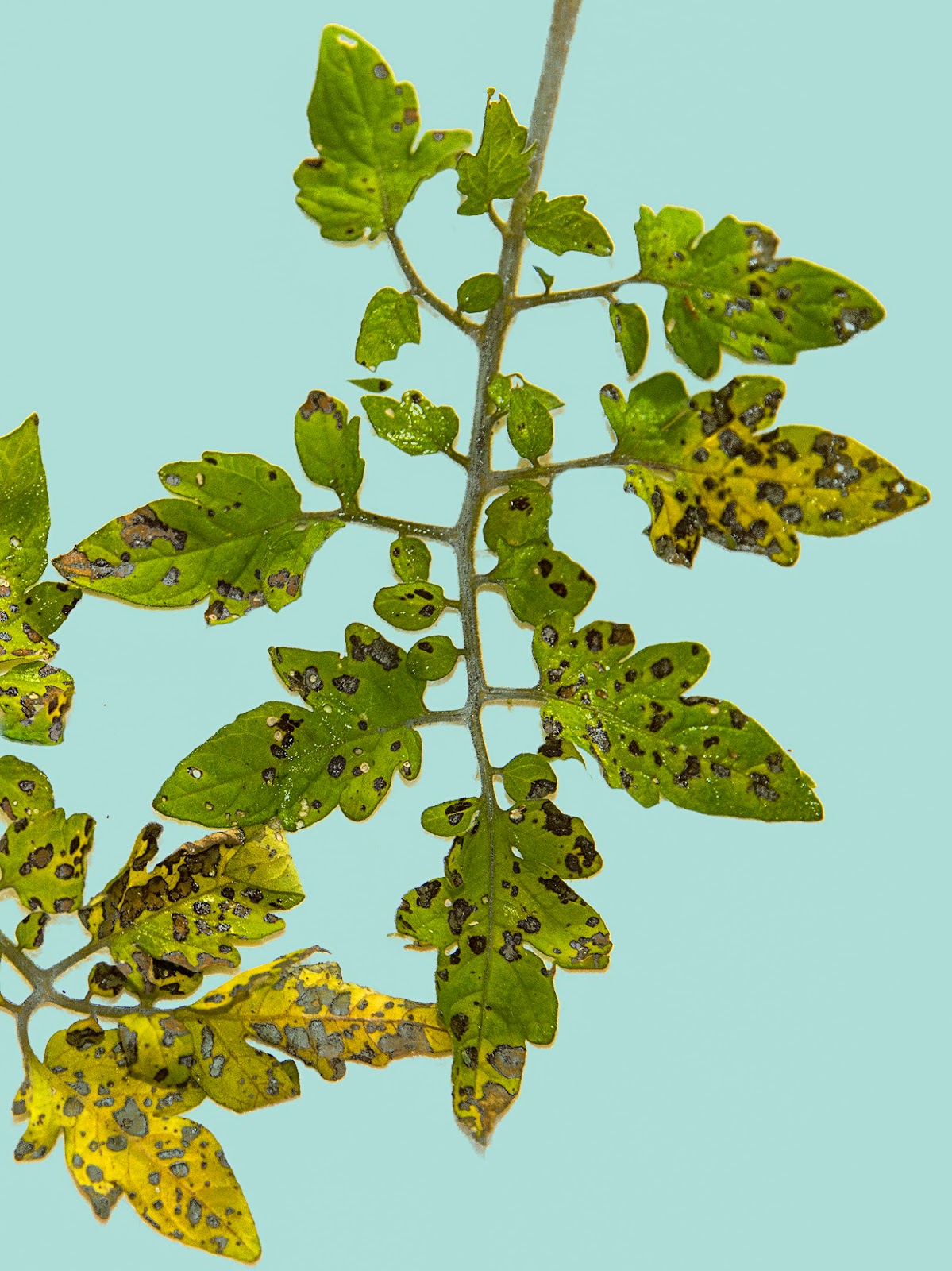
Tomato Leaf Diseases

Tomato plants susceptible to many diseases, disorders

Bill Sevier: Ask a Master Gardener

Tuesday, June 16, 2015

Q. My tomato leaves have large brown spots. What is this and what should I do? Leo, Tulsa

A. There are many diseases and disorders of our favorite vegetable, tomatoes. They may occur at different times of the growing season and simply may be incidental with little effect on the plants’ health and fruit production, or they can be devastating.

When tomato leaves develop disease patches, there are not only several fungal diseases to consider, but also a few caused by bacteria. Some of these leaf infections may also infect the fruit. There is a wide difference in disease susceptibility among the different tomato cultivars. These diseases often develop in similar situations, a fact that can be used in their control.

Many of the disease-causing organisms overwinter in the soil, in last season’s plant litter or nearby weeds. To lessen the chance of carry-over of disease from one year to the next, all garden trash and weeds should be removed in fall and the soil tilled to expose the microorganisms, as well as insects, to the winter weather.

Another strategy to reduce these problems is to rotate tomato planting sites. This will prevent disease buildup in the soil. If the size of the garden permits, you should rotate the planting site every three or four years. Also, it is best not to plant close relatives of tomatoes — potatoes, eggplant and peppers — in the same areas.

These infections need wet leaves to grow. If you eliminate overhead watering and water only the base of the plant, this will help. Also, watering should be done in the morning so the plants can dry by night.

Water splashing on the ground from irrigation or rainfall commonly carries soil organisms to leaves, causing infection. A generous layer of most any mulch will prevent splashing. Also, cages to keep plant leaves and fruit off the ground is effective in reducing infections.

If a disease has been a problem in the past or if you catch a disease early, treatments are available as a spray, usually applied every seven to 10 days. Most infections are due to fungi, so a fungicide such as chlorothalanil (Ortho Garden Disease Control) or myclobutanil (Immunox) may be used. Copper sulfate-based fungicides, such as those sold by Bonide, also treat bacterial infections and can be used in rotation with the other fungicides. This gives better coverage and prevents disease resistance.

Remember, no chemical pesticide will get rid of existing disease; at best it only prevents new disease. The non-chemical preventative measures mentioned above is the most effective tool.

For additional information about tomato disease, call the OSU Master Gardeners at 918-746-3701 or go to the vegetable section of tulsamastergardeners.org for links to several OSU fact sheets dealing with problems.

Garden tips

Renovate overgrown strawberry beds after the last harvest. Start by setting your lawnmower on its highest setting and mow off the foliage. Next thin crowns 12 to 24 inches apart. Apply recommended fertilizer, pre-emergent herbicide if needed and keep watered.

White grubs will soon emerge as adult June beetles. Watch for high populations that can indicate potential damage from grubs of future life cycle stages later in the summer.

Fertilize warm-season grasses at 1 pound of nitrogen per 1,000 square feet. Don’t fertilize fescue and other cool-season grasses during the summer. Because nitrogen is soluble in water, much of it may have been lost due percolation and runoff if you fertilized before recent rains.


Saturday, June 6, 2015 0 comments By: Ask A Master Gardener

Selecting and Using Ground Covers

Plant groundcover plants in shady spots of your lawn

Lisa Klein: Ask a Master Gardener

Saturday, June 6, 2015

Q: I am struggling to grow grass in some heavily shaded areas in my yard. Besides mulch, what are my options? Susan, Sand Springs

A: For extremely shady and troublesome landscape sites, groundcover plants can be the answer. They are low-growing, usually less than 24 inches high.
Look for groundcovers that will spread quickly and be dense enough to suppress weed growth.

Other areas of the landscape well-suited for groundcover are extremely hot and dry areas, steep slopes or places that are difficult to mow. Groundcovers also provide added visual appeal when used as shrub borders and to soften hardscapes.

Groundcovers come in many sizes, textures and colors. They can be herbaceous, woody succulent or grassy.When making your selections, you should ask yourself some questions. Is my site shady or sunny? Is the soil moist or dry? Do I want something tight and low growing or would something taller look better? Do I want something that flowers or would some variegation be more attractive?

A significant number of plants are often required to establish groundcover, so making smart choices will save money and avoid more problems. Whenever you are working with difficult planting areas, proper site preparation is essential. Many groundcovers prefer a slightly acidic to neutral soil. A soil test is always recommended and will indicate if you need any corrections.

A generous amount of good quality organic matter should be worked into the plant site, especially if you have heavy clay soil. Certain groundcovers spread by offshoots or runners and good drainage and aeration will allow plants to fill in more quickly.

Any existing turf grass and weeds should be removed. If necessary, glyphosate herbicide can be used a couple weeks prior to planting. If your space is especially weedy, you might consider using weed barrier fabric.
Depending upon the size area you need to cover and the plant or plants you have chosen, you can calculate the number of plants needed if you know the spacing of the individual plants. Plant a layer of mulch to help control weeds and maintain soil moisture. Continue watering and weeding until groundcovers are well established.

Once established, a groundcover will not be maintenance free, but you should be rewarded with a low-maintenance year-round addition to the landscape.
For additional information, you can access the Tulsa Master Gardener website for groundcovers in the Lawn and Garden section.

Garden tips
Yellow leaves may be due to too much water in the soil. With the deluge of recent rain and the subsequent saturation of the ground, some plants may show damage, often yellow leaves on the lower part of plants. This occurs both in ornamental and vegetable plants.

Commonly, yellowness is due to lack of iron or nitrogen in the soil. However, when the soil is saturated with water, oxygen is forced out of the air spaces and the roots suffocate. This prevents them from absorbing nutrients, resulting in the yellow appearance. As the soil dries out, this problem will correct itself.

Some pests can be hand-picked without using a pesticide. Do not spray if predators such as lady beetles are present. Spraying insecticides early in the morning or late in the day will avoid spraying honeybees and other essential pollinators.